
It’s time.
I’ve gone back and forth on whether the 13th Region should move to a Super Regional format, but after watching the games at The Arena this past week, I believe it may be time to seriously consider it.
When it comes to competitiveness, this year’s boys’ and girls’ tournaments were among the least competitive in recent memory. From many of the folks I’ve spoken with on press row, that sentiment seems to be widely shared.
The average margin of victory so far in the boys’ tournament is 21.3 points while on the girls’ side it was 25 points per game.
A Super Regional format would allow every school a fair opportunity to reach the regional tournament.
One possible approach would be eliminating the district qualification system and instead seeding the Super Regional field using the RPI, ensuring that teams are placed in the bracket based on their full body of work throughout the season.
Since they’re 17 schools on the boys’ side, this is what I figured would attempt to work out best for a 13th Region Super Regional Tournament.
Under my thought of a Super Regional format, all 17 schools in the region would have the opportunity to participate in postseason play while still preserving the traditional neutral-site atmosphere for the later rounds at The Arena.
The tournament would begin with a play-in game, featuring the region’s two lowest seeds.
The No. 16 seed would host No. 17, with the winner advancing into the main bracket as the No. 16 seed.
This play-in matchup reduces the field from 17 teams to 16, allowing the tournament to proceed with a traditional bracket format.
Following the play-in game, the first round would be played at the home court of the higher seed. The matchups would feature No. 1 vs. the winner of the 16/17 game, No. 8 vs. No. 9, No. 5 vs. No. 12, No. 4 vs. No. 13, No. 6 vs. No. 11, No. 3 vs. No. 14, No. 7 vs. No. 10, and No. 2 vs. No. 15.
Each of those eight games would be hosted by the higher-seeded team, rewarding regular-season success while trimming the field to eight teams.
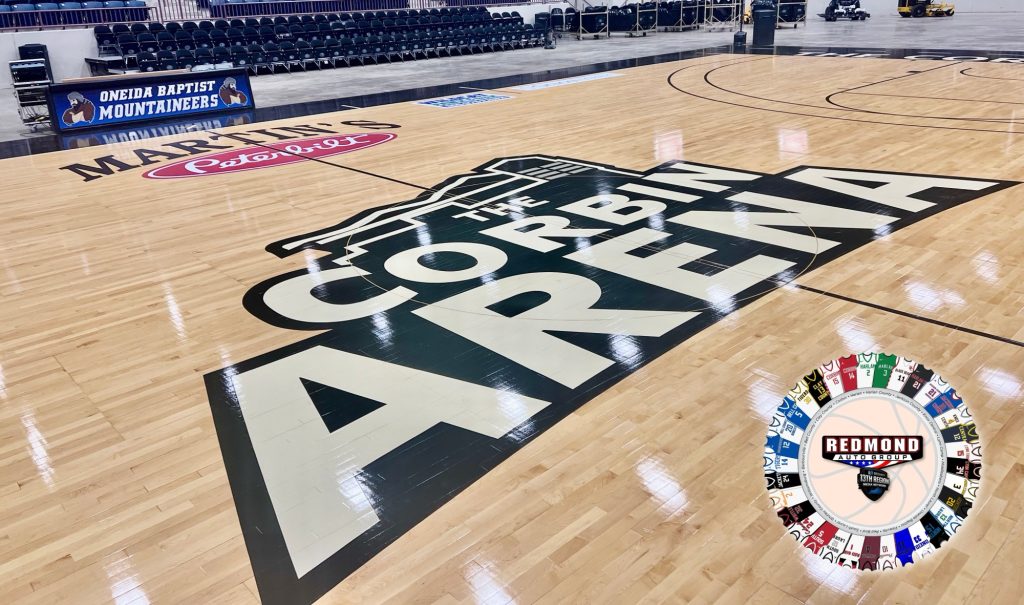
The eight winners would then advance to the Corbin Arena, where the tournament would continue with the quarterfinals, semifinals, and championship played at a neutral site.
On the girls’ side, the format would be slightly different due to the region having 16 schools, eliminating the need for a play-in game.
Instead, the tournament would begin immediately with a traditional 16-team bracket.
The opening round would be played at the home court of the higher seed, rewarding teams for their regular-season performance.
First-round matchups would include No. 1 vs. No. 16, No. 8 vs. No. 9, No. 5 vs. No. 12, No. 4 vs. No. 13, No. 6 vs. No. 11, No. 3 vs. No. 14, No. 7 vs. No. 10, and No. 2 vs. No. 15.
Each of the eight first-round games would be hosted by the higher-seeded team. The winners of those matchups would then advance to the Corbin Arena, where the tournament would continue with the quarterfinals, semifinals, and championship game to determine the region champion.
A Super Regional format would bring several advantages, especially for a competitive area like the 13th Region where there are many schools and strong programs. Some of the biggest benefits include:
More teams get a postseason opportunity.
Instead of only district finalists qualifying for the regional tournament, a Super Regional would allow all schools in the region to participate, ensuring that strong teams from deep districts are not eliminated before reaching regional play.
Rewards regular-season performance.
Higher seeds would host early-round games on their home courts, which gives teams an incentive to perform well during the regular season. It also creates a true advantage for top seeds rather than forcing everyone into a neutral-site bracket from the start.
Creates more excitement and fan engagement.
Early-round games at local gyms would generate strong crowds and community interest. Schools hosting postseason games often draw packed houses, which can create a postseason atmosphere across the region before the tournament even reaches the arena.
More meaningful games and storylines.
With additional rounds and matchups, the format would produce more compelling storylines—upsets, rivalry games, and deeper tournament runs that build excitement heading into the arena rounds.
Maintains the traditional regional championship atmosphere.
Once the field is trimmed to eight teams, the tournament would move to the arena for the quarterfinals, semifinals, and championship, preserving the big-stage environment that fans and players expect from regional tournament play.
Overall, a Super Regional format blends home-court excitement early with the traditional neutral-site championship feel, while also giving more schools a chance to compete for a regional title.